Robinhood Chain · 4663
Place gates on a grid, run them on an exact state2n-amplitude simulation, and watch every qubit's Bloch vector move. Eight core algorithms ship as circuits you can open, edit and run. Nothing here is a video of a quantum computer.
Five things, in order. Each one is a page you can go and use rather than a claim on a landing page.
Four qubits running the entanglement recipe, live, below. Every arrow starts at the north pole, because every qubit starts in |0⟩. The ladder of CNOTs pulls the arrows toward the centre one at a time, and an arrow that has shrunk is a qubit that is now entangled: a mixed state cannot sit on the surface of the sphere. The chart on the right is the same run, seen as outcomes.
Not a video of a quantum computer, and not an animation that claims to be one. A dense statevector, a gate library checked against independently computed unitaries, eight algorithms that verify their own claims on every test run, and a chain client that commits to a result without pretending to verify the computation behind it.
There is no box. What runs when you press RUN is an array of 2ⁿ complex numbers — one amplitude per basis state — and a gate is a single strided multiply over that array. At twenty qubits the array is eight million entries and the tab stops being interactive; at thirty it would not fit in this machine's memory at all.
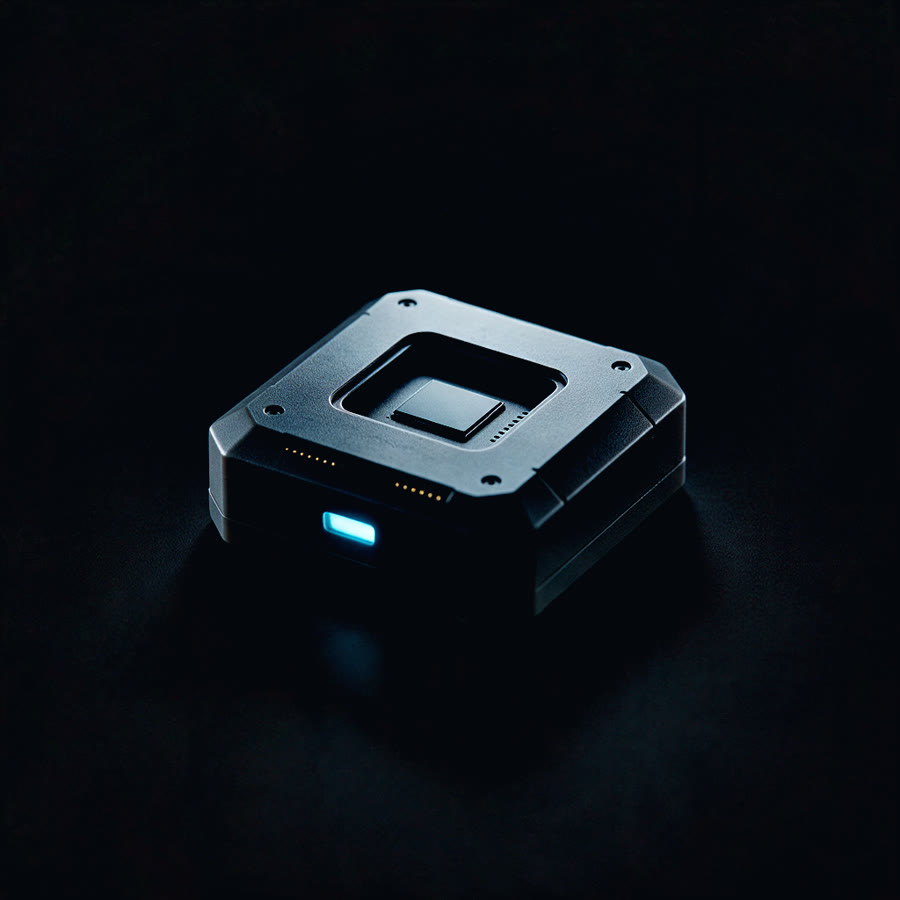
So the object on the left is a render, and it is the most honest picture of this computer anyone can make. What the site is for is the part you can actually check: paste a circuit and read the state it prepares, rather than take anyone's word for it.
Verify a circuitEvery one of them is a real circuit built from gates, with an optimiser where an optimiser belongs, and a claim the test suite checks on every run.
All eight, with the mathematicsThis is a classical simulation with the same memory asymptotics as the quantum algorithm: 2ⁿ complex amplitudes, so about 20 qubits is the practical ceiling. There is no noise model. The oracle gate is a black box. The on-chain registry records a claim, not a computation.
Every one of those sentences is also written on the page where it matters, in the contract header, and in the gate's own tooltip, rather than only here.
Read the limitationsAlidade / Console
Place a gate, then click a cell. Drag a placed gate to move it. Scrub the timeline and the path every qubit took is drawn behind it. Every edit re-simulates, so what you see is what ran.
run a circuit to produce a digest.
Alidade / Algorithms
Alidade / Verify
Paste a circuit — OpenQASM 2.0, or the compact gate syntax the CLI and the MCP server speak — and this runs it on the exact statevector simulator and reports what it actually prepares: every amplitude with its phase, what each qubit reads on its own, and where the entanglement is. Nothing here is sampled, estimated, or inferred from a description.
Optional. Paste a digest someone gave you — from a job record, a chain entry, or a message — and this says which of the two digests below it is, or that it is neither.
A link carries the circuit, its register width, the seed and the shot count — and the claim in the box above, if there is one. Opening it re-runs the same circuit at the same seed and reproduces both digests, which a link carrying only the drawing would not.
Alidade / Verify / Compare
Paste a circuit on each side. This is the question a compiler is really asking — is the thing that came out the same as the thing that went in? — and the one two drawings cannot answer, because a decomposed circuit looks nothing like the one it came from and is usually that circuit exactly. Both sides are run on the exact statevector here, so the answer is measured rather than judged by eye.
A global phase is not a difference. No measurement can see one and every compiler is free to introduce one, so it is divided out before any distance is measured — otherwise |1⟩ against −|1⟩ reads as two states two apart that are one state.
Alidade / Noise
Everything else here is exact. This is not, and that is the point of it: a circuit that prepares the right state can still fail on real hardware, and the reason is noise. The same circuit is run twice below — once exactly, once through a model of a noisy device — and the two answers sit side by side.
The model is not a measurement. It applies depolarizing noise after every gate at the rates you set, plus a chance that a measured bit is reported flipped. Those rates are plausible for a current device and describe no particular one. Every number on the right is estimated from a finite number of trajectories and carries the error that comes with that, which is why the error is printed next to it — and why the exact answer is still there beside it, unchanged.
Rates you choose, for a machine nobody measured. Moving one re-runs the comparison.